
Frequently asked questions
What prospects, cooperatives, donors and local authorities ask us before engaging the Technology division.
XP-NOVA’s role
What we do, and above all what we do not do.
Do you sell or install equipment?
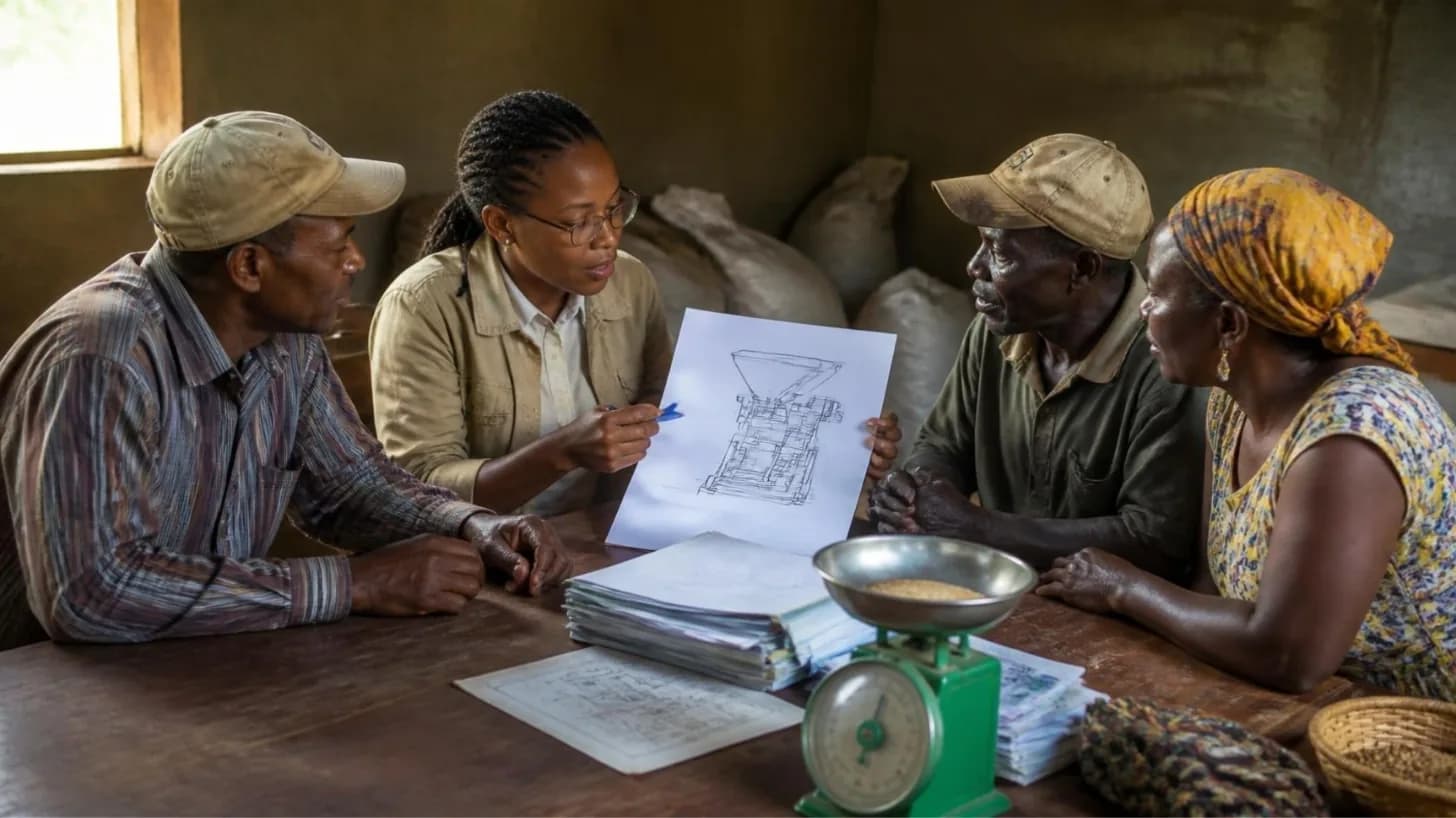
No. XP-NOVA Technology does engineering: needs analysis, options comparison, sizing, specifications, bid analysis, testing and acceptance. Supply, installation and maintenance go to contractors you select on the basis of our specifications. We receive no commission.
Our services →Why use an engineering consultancy rather than ask a supplier for a quote?
A supplier sizes on its catalogue; we size on your reality: available raw material, reliable energy, local skills, spare parts. The specifications we write make bids comparable and protect you from oversizing as much as undersizing.
Do you recommend brands?
No. The reference classifies equipment by technical function, never by brand. Our specifications set performances, operating conditions and selection criteria weighted in advance; the supplier is chosen afterwards, bids in hand.
The reference →Do you issue certifications?
No. An XP-NOVA performance verification establishes that equipment reaches the contractual thresholds; it replaces neither an ANOR certification, nor a CNHPCAT registration, nor a sanitary approval. We tell you which ones are required and when.
Request, lead times and costs
How a mission starts, how long it takes, when the quote arrives.
What does a first request cost?
Nothing. Submitting a request is free and without commitment. You receive a first reply within 48 working hours. The mission quote, in FCFA, is issued only after the file is officially opened, once the need is framed.
Submit a request →How long does a mission take?
Each service carries a published indicative duration: 2 to 5 days for acceptance support, 10 to 20 days for a technical architecture. A full chain, from needs analysis to specifications, most often takes four to eight weeks depending on the availability of site data.
Durations by service →Can you step into a project already under way, or an existing plant?
Yes. Services are ordered separately: an audit of the existing situation (TS-01), an analysis of bids already received (TS-06), tests before acceptance (TS-07 and TS-08) or a maintenance plan derived from the life-cycle grid.
Do you work outside Yaoundé?
Yes, throughout Cameroon and Central Africa. Site mission expenses are shown separately in the quote. Part of the work (options, sizing, specifications) is done remotely from the data you provide.
The RT-TECH reference
Reading the codes, types and notes of the equipment reference.
What is the equipment reference for?
To name a need unambiguously. Its 50 sub-functions (T1.1 to T8.7) cover production, processing, storage, energy, logistics and digital. Each sheet gives typical equipment, sizing parameters, risks in Cameroon and the regulatory framework.
Explore the reference →What does a code like T2.2·TS-04 mean?
T2 is the domain (Irrigation and water), T2.2 the sub-function (Pumping), TS-04 the service (Sizing). The code therefore designates the sizing of a pumping system. From a reference sheet, this code is pre-filled in the contact form.
Physical, digital, hybrid: what is the difference?
Physical equipment works without software (an oil press). Digital equipment is software or a data service (an ERP). Hybrid equipment is a physical device driven or measured by digital control (a regulated solar pump, a monitored cold room).
Why are some standards marked "framework being confirmed"?
Because we cite a standard or authority as mandatory only after reading the text. International references (ISO, IEC, Codex) are used to write specifications; whether they are mandatory in Cameroon depends on the list of standards made compulsory by ANOR, which we check domain by domain.
Cameroonian context
Electricity, parts, customs and export regulation: what our studies include by default.
Do you take power cuts into account?
Systematically. Every study of sensitive equipment (cold chain, hatchery, processing) includes a continuity budget costed in FCFA: backup energy, automatic switchover, critical stock. At acceptance we require a loaded continuity test, with the grid deliberately cut.
Energy and utilities →How do you handle spare parts and maintenance?
Through the CV1 to CV9 life-cycle grid applied to every option. Local availability, parts lead time, maintenance skills and operating cost are scored before the purchase price. A machine with no parts or repairer in your region is ruled out even if it is the cheapest.
Equipment life cycle →Must imported equipment go through PECAE?
In most cases, yes: ANOR requires a certificate of conformity to clear regulated imported products, with an exemption threshold for small shipments. We include it in the procurement schedule and cost (CV2) of each option.
Do you consider the EU deforestation regulation (EUDR)?
Yes, for cocoa, coffee and timber bound for the European Union: plot geolocation, batch traceability and documentation. Sub-function T8.6 of the reference and the AGROVITA division handle this aspect.
EUDR compliance (AGROVITA) →With the other divisions
When Technology works alone, when it supports AGROVITA, ODT or Training.
What is the difference between Technology and AGROVITA?
AGROVITA supports an agricultural or agro-industrial project from idea to first sale, in 13 steps. Technology handles the equipment side of those projects, or works alone when your need is purely technical: an existing plant, a donor, a cooperative, a local authority.
AGROVITA →Do you train operators?
We hand over transfer materials at acceptance (TS-09) and describe the skills required per equipment. Full training schemes are designed by the Training division and delivered by partner organisations.
Training engineering →Can you size community equipment for a municipality?
Yes, in support of the ODT division: collection warehouse, solar mini-grid, equipped borehole, municipal slaughterhouse. ODT leads the territorial operation; Technology provides the equipment engineering.
ODT →The more concrete your description (area, volumes, available energy, site), the more useful the first reply.